
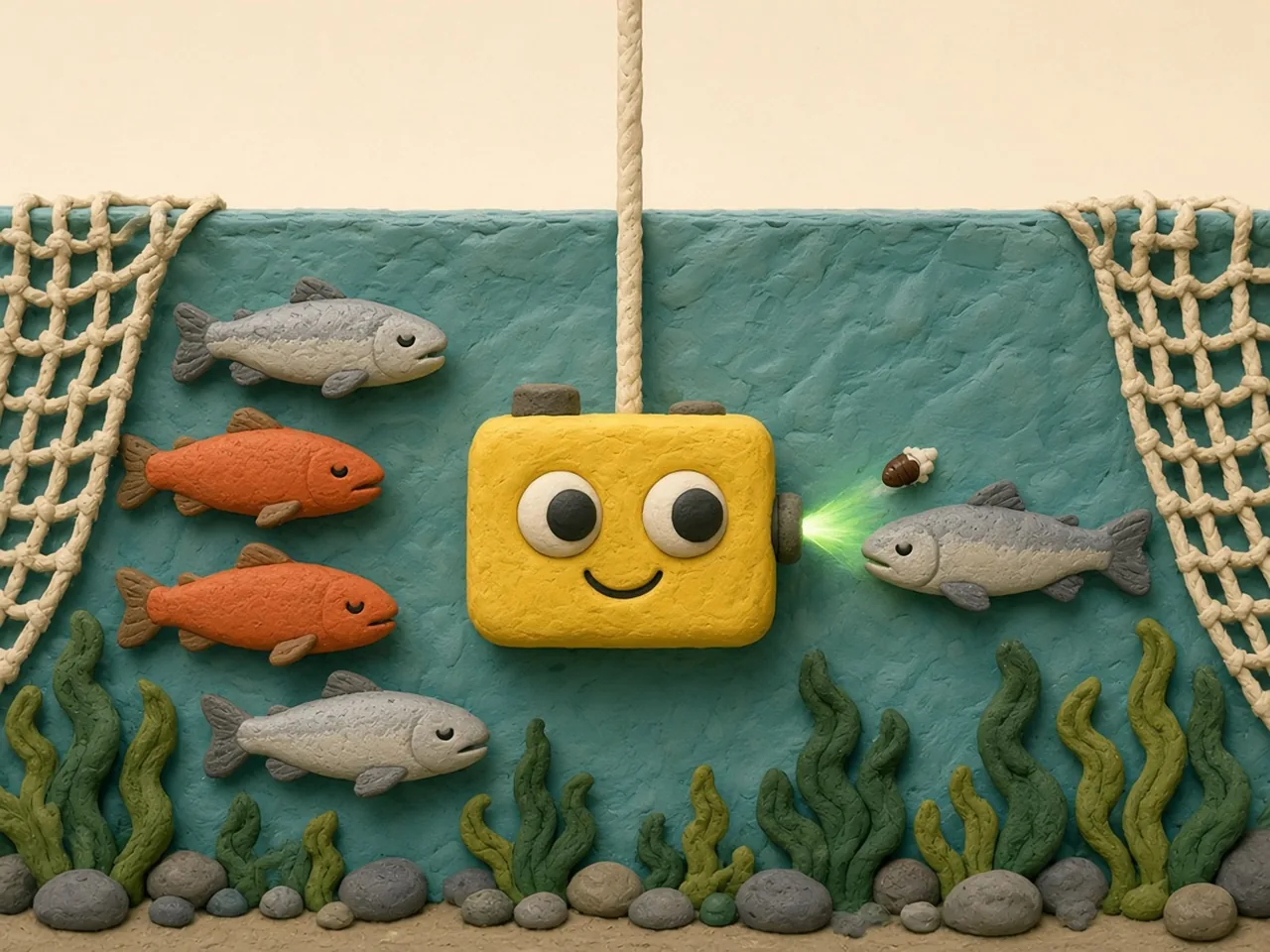
A sea louse is a small parasite that latches onto a salmon’s skin and feeds on it. Norway strictly limits how many lice a farm may carry, and the lice have built up resistance to most of the medicines farmers used to rely on. So farmers increasingly turn to mechanical delousing, which means handling the fish. In a Norwegian Veterinary Institute survey, injuries after delousing ranked among the top causes of death for salmon in sea pens.
The clever bit
Stingray Marine Solutions, an Oslo company, leaves the fish in the water and sends a camera unit into the pen. Stereo cameras film salmon as they swim by, with royal-blue light to make lice stand out against the fish’s skin. Machine-learning detectors, trained on labeled images, pick out each louse, and a laser fires a pulse at it, up to five times a second, day and night. The fish swim on.
Hooray
More than 2,500 of these units are now at work. Stingray says they watched over 120 million fish a day in 2025, across 173 farm sites and 986 net pens. Salmon Business reported about 2,565 units installed at customer sites at the end of 2025, with production up from 740 units in 2024 to more than 1,250, and a goal of about 1,600 in 2026.
The payoff shows up in national records. Stingray researchers and a University of Bergen statistician took public lice and treatment data for every Norwegian farm site in 2023. At a sea temperature of 10°C, sites without lasers had a 10.1% chance of needing a treatment in a given week. Laser sites had 5.06%. They didn’t carry more lice for it, and they leaned less on cleaner fish. A newer econometric analysis from the same group came out in Aquaculture this month.
Lice lasers have been shown to keep lice levels down. We can then avoid many mechanical delousing measures and thus we avoid stressing the fish leaving them swimming in peace and quiet.
— Karl Fredrik Ottem, head of fish health, Cermaq Norway, via cermaq.com
What comes next
Stingray aims to deliver about 1,600 units this year. What would settle the argument is an independent test at today’s scale. The Institute of Marine Research team behind the 2020 trial asked for exactly that: testing across more sites, conditions and cage types before the whole industry signs on.