
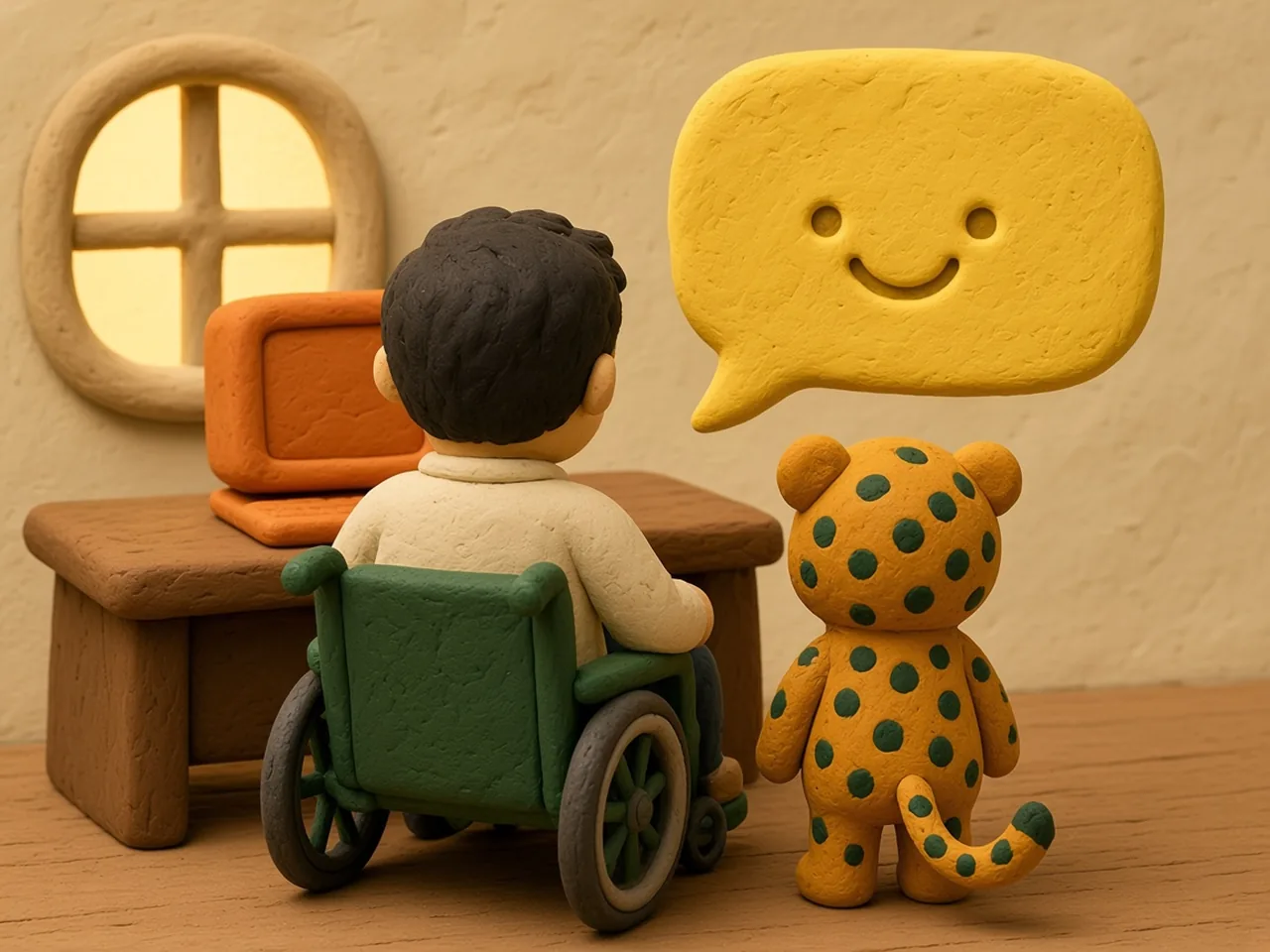
Casey Harrell began losing his speech soon after an ALS diagnosis in 2020. By the time of his surgery, only his wife, Levana, and his assistant could fully understand him, and he didn’t join even a video call without one of them there to translate. In July 2023 he joined the BrainGate2 clinical trial at UC Davis, where a neurosurgeon placed four tiny electrode arrays on the part of his brain that controls speech.
The clever bit
When Harrell tries to say something, 256 electrodes pick up the signals his brain sends toward the muscles of his mouth and throat. Machine learning matches those patterns to 39 English speech sounds, and a language model assembles the sounds into words and sentences. The words appear on a screen, he proofreads them, and the computer can say them out loud.
On the second day of testing, with a 125,000-word vocabulary switched on, his second sentence was “I’m looking for a cheetah.” Leigh Hochberg, the BrainGate director watching on a video call, was sure the decoder had slipped. He couldn’t see that Harrell’s 4-year-old daughter had just bounded into the room in her cheetah costume.
A study in Nature Medicine in June tracked what came after. Over nearly two years, Harrell used the system at home for more than 3,800 hours with no researchers present. He communicated 183,060 sentences, close to 2 million words, at an average of 56 words a minute. He rated 92% of the sentences at least mostly correct, and in formal tests the decoder got more than 99% of words right.
It was so amazing to be able to be understood right from the get-go and to be able to talk and respond to my daughter, especially because that was lacking completely from my life.
— Casey Harrell, BrainGate2 trial participant at UC Davis, via sciencenews.org
Hooray
Harrell works full time again. He talks through the system for about 10 to 14 hours a day, sending email and Slack messages, playing Wordle with his wife and daughter, and getting a new climate consultancy project off the ground.
What comes next
For now the device is wired and stays at home. Other teams are testing fully implanted, portable versions, and UC Davis said in June that the BrainGate2 trial was still enrolling. Harrell’s hope is a day when he is one of many users instead of one of one.