
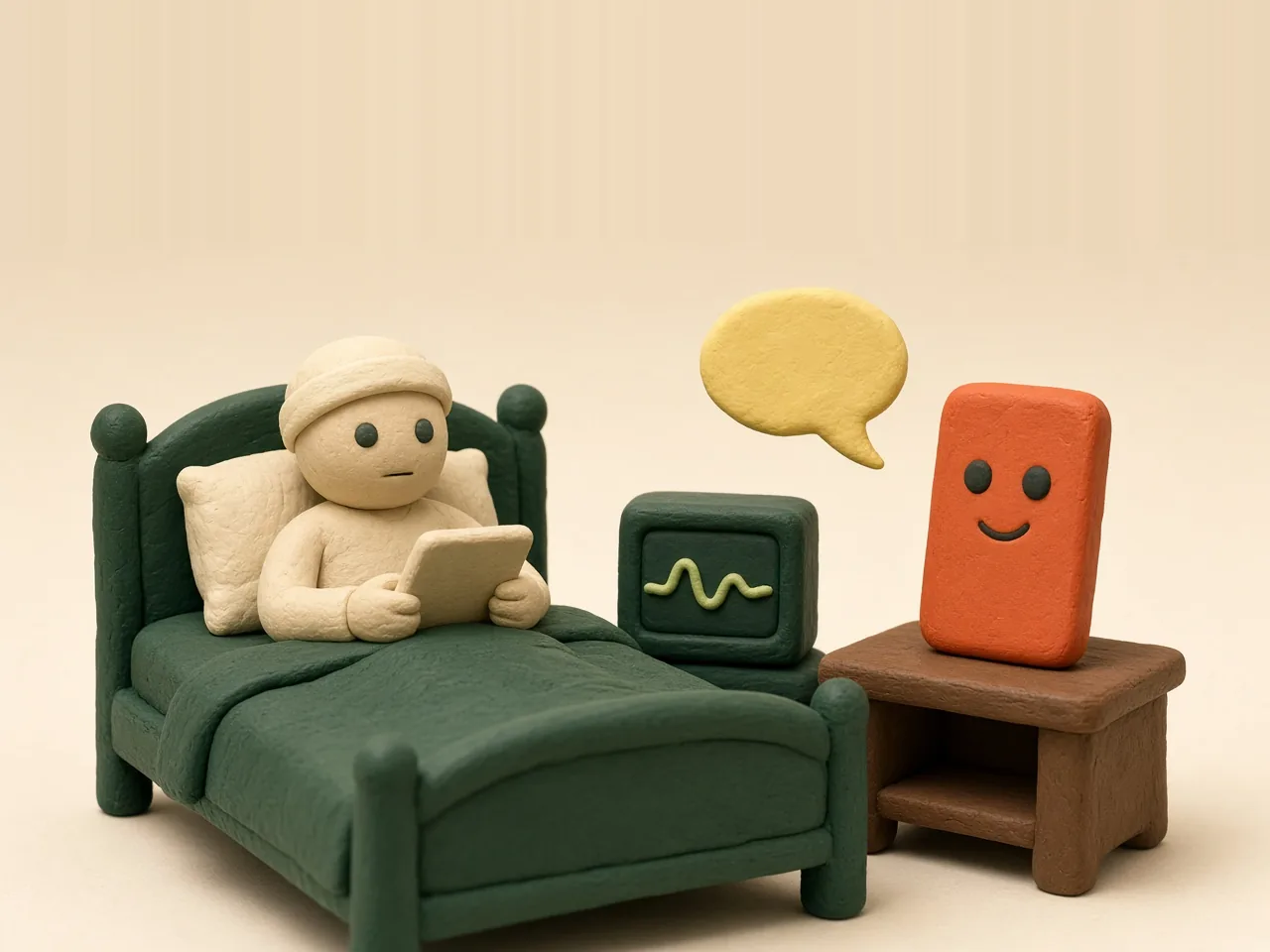
In an epilepsy monitoring unit, brain waves stream all day to machines that mostly talk to clinicians later. Patients living through those days usually get little of that stream in the moment—even though they are the ones who feel the seizures, the sleep, and the false alerts.
Researchers at the University of Pennsylvania linked each patient’s live EEG to a HIPAA-compliant cloud and a smartphone chat. Thirteen adults in Penn’s epilepsy monitoring unit could ask about seizures, sleep, and trends, answer thrice-daily check-ins, and mark seizure alerts as true, false, or uncertain. The system answered most data questions accurately; investigators reviewed every message daily.
The clever bit
The clever bit is the feedback loop. When the detector cried wolf, patients said so. Those labels later retrained the model every few hours in a simulation that mirrored a live rollout—without a clinician in the loop.
Patients and the system exchanged 1,307 messages. Of 58 real-time seizure alerts, patients answered about two-thirds. In the simulation that reused those answers, the median false-alarm rate fell about 80%—from roughly 0.74 an hour to 0.10—while sensitivity held. Five of thirteen asked, unprompted, to take the system home.
More importantly, both the patient and the device can learn together over time. The device learns what matters to the patient, and the patient learns how their behavior affects their health.
— Brian Litt, MD, professor of Neurology, Neurosurgery, and Bioengineering, University of Pennsylvania, via pennmedicine.org
Hooray
Hooray: people in the ward taught the seizure detector to quiet down—about an 80% drop in false alarms in simulation—and several wanted the chat to come home with them.
What comes next
Penn and NIH frame this as a hospital proof of concept. Larger outpatient studies are planned, including work that would let patients help tune deep-brain stimulation for Parkinson’s. For now, families should keep their usual care plans; this app is not a discharged product.