
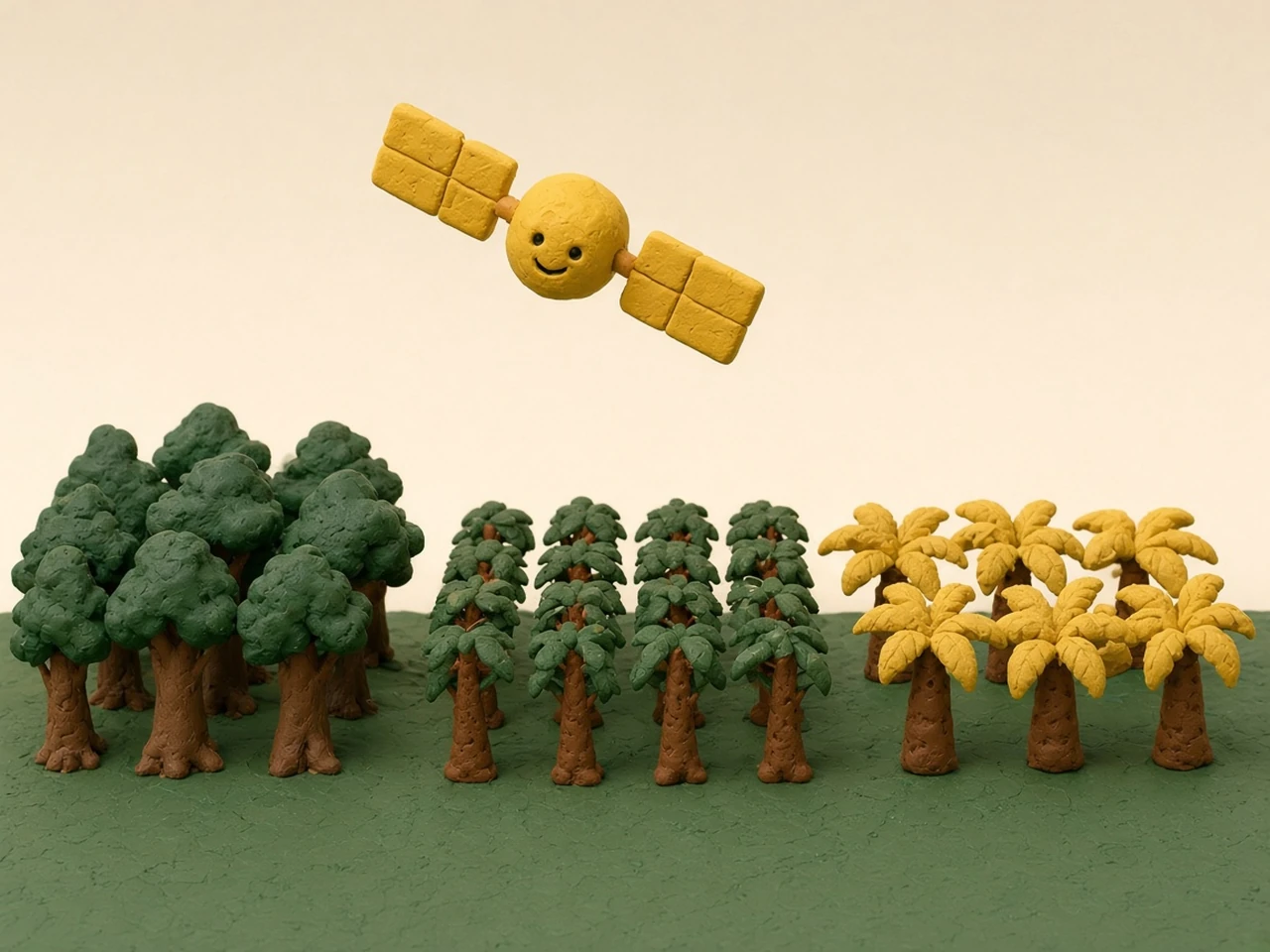
Look down from a satellite and a centuries-old rainforest, a eucalyptus timber block and an oil palm estate can all show up as green. They hold very different amounts of carbon and wildlife, and companies shipping coffee, cocoa, palm oil or wood into the European Union now have to know which is which.
Most global maps only say whether trees are present. That misses changes that stay green: a natural forest logged and replanted as a plantation can look like forest again within a few years. The EU’s deforestation regulation needs a 2020 baseline that separates primary forest, regenerating forest, planted forest, plantations, and tree crops such as oil palm and rubber, which the rules treat as farmland.
The clever bit
Google DeepMind and Google Research, working with the World Resources Institute and IIASA, trained a cascaded deep-learning pipeline on about 1.7 million labeled locations. The model reads AlphaEarth Foundations embeddings, compact summaries of years of satellite observations for each 10-meter pixel, so it can pick up planting patterns and harvest rhythms that a single snapshot can miss. Forest Typology (ForTy) gives a confidence score for each of six classes rather than a single yes-or-no label.
Independent validation used a stratified random sample of 9,100 sites worldwide. Two trained experts reviewed each site, and 8,190 reached consensus. Overall accuracy for the six-class map was 90.2%. Natural forest versus everything else reached 94.8%, and forest versus non-forest reached 95.5%. On the same sites, ForTy beat the European Commission’s four-class forest-type map by 3.1 percentage points (90.9% versus 87.8%) and its forest/non-forest map (95.5% versus 93.6%).
Hooray
The 2020 map is free to download and to explore in Google Earth Engine, under a Creative Commons licence. The authors say no existing global dataset had resolved this six-class typology at high spatial resolution. Sample-based estimates put natural forest at about 3,890 million hectares and tree crops and agroforestry at about 196 million hectares.
What comes next
Planted forests were the hardest class to call, with an F1-score of 58.2%, and a harvested plantation can look like bare ground in a single year of images. DeepMind also released an early year-by-year series for 2017 to 2025 that tries to show what replaced cleared forest; that series is not part of the peer-reviewed paper. The team says it will keep improving the series.